
Correspondence: The Twentieth Conference of Historical Theories Studies Held in Beijing
2017-11-24
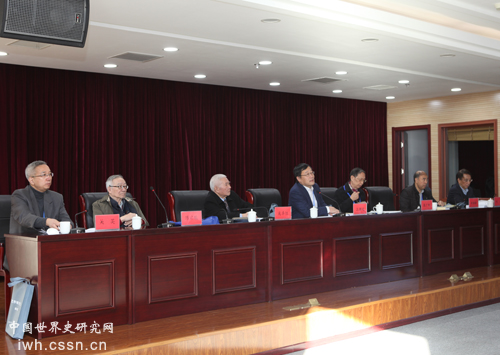
On November 14-15th, 2017, the 20th conference of historical theories studies was held in Beijing. It was co-organized by Historiography Quarterly, CASS, “Key Program of Historical Theories Studies”, CASS and Center of Historical Theories Studies. Over 90 scholars from IWH, Peking University, Renmin University of China, Fudan University and other institutes, universities and presses attended the conference.
Researcher Ying Wu (executive vice-editor-in-chief of Historiography Quarterly) presided over the opening ceremony. Researcher Chaoguang Wang (associate director of IWH, editor-in-chief of Historiography Quarterly) gave the opening speech. Researcher Chaoguang Wang welcomed all of the scholars coming for this conference and discussed the importance of historical theories as a guide to historical studies by instances from his own academic research.
The 5 lectures of main meeting was presided over by Researcher Ying Wu.
Qineng Chen (Researcher of IWH) offered a retrospect to the respective histories of Historiography Quarterly, conference of historical theories studies and the subject of historical theories studies in China. He pointed out that the academic atmosphere in China today is very different from what it was 30 years ago, and we should adopt Socialism with Chinese characteristics in the New era to guide our research on historical theories from now on.
Zhuoheng Pang (professor of School of History and Culture, Tianjin Normal University) emphasized that historiography is identical to natural sciences in essence according to Karl Marx’s comments. He took the recent debate over the meaning of and relationship between Karl Marx’s “the two inevitabilities” and “the two never” among Chinese scholars of Marxism to explain that the denial of the scientific nature of historiography must lead to inaccuracy in the evaluation of historical achievements, therefore we must defend the statue of historiography as a science.
Guangzhi Zhang (Professor of Department of History, Fudan University) gave a retrospect to the history of communications between Chinese and the western Marxist Historiographies. He believed that these communications can help us to learn from the western wisdom and improve ourselves. It is also the reflection of the strategy of “opening up” in contemporary China. Such communications can also exhibit excellent research by Chinese historians to the external world and provide renewed energy to Chinese Marxist historiography.
Runzhen Niu (Professor of Renmin University in China) pointed out that in order to find out the modern value of traditional historiography, we have to take the perspective over history and present, so as to combine them together and put historical experience into modern context, as well as to explain and settle problems in real life by historical studies. He took the ancient capital Ye as an example, summarized the influence of its layout to other traditional capitals in East Asia, and concluded the role which the traditional capital layouts could play in modern civil construction and city design.
Ping He (Professor of Department of History, Sichuan University) pointed out that the global perspective has already taken shape in world history studies. He discussed in particular the studies of global history, transnational history and transcultural history. He noticed that a lot of recent influential research in world history benefits from the adoption of these perspectives. To realize the paradigm shift in time and to grasp the new perspectives, questions and methods can be helpful to promote our historical research and gain a profound understanding of the development of modern history.